
Decoding India’s K-Beauty Consumer: Demographics, Demand and Product Strategy

Term | Meaning |
BCD | Basic Customs Duty |
CEPA | India–Republic of Korea Comprehensive Economic Partnership Agreement |
Demand cell | A group defined by need, life stage, spending room, involvement, access and occasion |
GMV | Gross merchandise value transacted at consumer level; not the same as brand revenue |
HCES | Household Consumption Expenditure Survey |
IGST | Integrated Goods and Services Tax, including tax collected on imports |
LTV | Customer lifetime value, ideally contribution-based rather than revenue-only |
MPCE | Monthly per-capita consumption expenditure; not income or a beauty budget |
MRP | Maximum retail price, inclusive of taxes |
NSP | Normal selling price most commonly observed outside short events |
Price corridor | A strategic test range by category, pack and role—not a fixed national rule |
Routine cost of ownership | Cash, cognitive and replenishment burden created by sustained product use |
SWS | Social Welfare Surcharge on applicable customs duties |
TAM | Total addressable market; should be defined to match category scope and qualified demand |
UPI | Unified Payments Interface |
Executive synthesis
The Indian K-beauty opportunity is real, but its shape is commonly misunderstood. India has the world’s largest national population in 2025 at about 1.464 billion, a working-age majority, a large youth cohort, rising urbanization and more than one billion internet subscriptions. Beauty e-commerce and quick commerce have expanded rapidly, and Korean brands already occupy visible shelf space and digital mindshare. Yet average urban monthly consumption expenditure was ₹6,996 per person in 2023–24, while a widely sold imported Korean sunscreen carried an observed MRP of ₹1,570. That single comparison does not define affordability, but it reveals the central commercial tension: the premium can be desirable long before it becomes routine.
The real Indian opportunity is not a billion consumers. It is a sequence of increasingly reachable consumer cells.
Twelve conclusions for Korean decision-makers
1. Do not use population as TAM. A qualified K-beauty consumer must have a relevant need, discretionary capacity, category involvement, channel access and enough confidence to repeat. The multiplication of those conditions, not the national population is the commercial market.
2. Youth is the acquisition engine, not the whole revenue pool. People aged 15–29 represented 27.3% of the population in 2021, but the share is projected to decline to 22.7% by 2036. Young consumers accelerate trends; established professionals, affluent households and mature consumers can finance higher-value routines and should not be invisible.
3. Urbanization increases commercial density, not uniform wealth. The official projection takes India’s urban share from 31.8% in 2011 to 38.6% in 2036. That concentrates logistics, creators, organized retail and high-income households but affordability still varies sharply across states, cities and neighbourhoods.
4. The middle class is a scenario, not a segment. PRICE estimates 432 million people in households earning ₹5–30 lakh annually in 2020–21 and projects 715 million by 2030–31. This is a useful demand runway under one methodology, not an official definition or an automatic K-beauty audience.
5. Cash outlay matters more than percentage premium. A student may accept that a Korean sunscreen is ‘worth’ four times a local option and still be unable to pay ₹1,570 today. Minis, discovery kits, lower-dose categories and hero-first routines reduce the risk of first purchase.
6. Price must be designed by category. The acceptable Korean premium is different for a sensorial lip mask, a high-trust sunscreen, a functional cleanser and a novel essence. One brand-wide multiplier against Korea or one universal India price band will misprice at least half the portfolio.
7. The monthly routine is the real product. Consumers experience acquisition ticket, depletion speed and repurchase frequency together. A full observed four-step K-beauty basket had a ₹6,060 MRP versus ₹1,802 for a reference science-led basket; the initial gap was 3.36× before depletion differences.
8. Minis are a pricing instrument, not decoration. Anua’s observed 40 ml toner at ₹500 cut the cash doorway by about 76% versus the 250 ml ₹2,050 full size, even though the mini’s nominal unit price was about 52% higher. That trade: lower risk, higher unit price can be rational when it is transparent.
9. Hallyu lowers discovery cost; proof earns replenishment. Korean entertainment and culture make the origin story recognizable. Repeat still depends on feel, results, trust, authenticity, routine fit and a price the household can absorb.
10. CEPA paperwork can be a profit lever. The original India–Korea CEPA schedule placed relevant HS 3304 lines on an eight-stage elimination path. Qualifying Korean-origin goods may therefore have a materially different border stack, subject to current classification, notification, origin rule and evidence. ‘Made in Korea’ by itself is not proof.
11. Promotion must be governed as net revenue, not visibility. At ₹1,299 MRP, consumer value excluding 18% GST is about ₹1,101. A 15% consumer discount reduces it to roughly ₹936 before platform fees, trade margin, fulfilment, returns or brand media. Discounting is therefore a unit-economics decision.
12. The entry sequence should expand a price staircase. Open with 6–10 SKUs across a ₹299–599 trial door, ₹699–1,199 accessible core and ₹1,200–1,799 hero tier; add prestige only where proof and service support it. Move consumers from trial to hero to routine not directly to a ten-step regimen.
Board dashboard: the facts that change pricing
Signal | Published / observed fact | Commercial implication |
Population | 1.46 bn in 2025 | Huge long-term ceiling; never treat it as addressable demand. |
Youth | 15–29: 27.3% in 2021; 22.7% projected for 2036 | Acquire through youth culture, but build a portfolio that ages with the market. |
Urbanization | 31.8% in 2011; 38.6% projected for 2036 | More concentrated addressability, with continued regional and city-tier dispersion. |
Consumption | Average MPCE ₹4,122 rural; ₹6,996 urban, 2023–24 | Imported hero SKUs can consume a meaningful share of monthly spending context. |
Digital access | 1.03 bn internet subscribers at December 2025 | Mass digital reach; subscribers are not unique users and rural quality/access still differs. |
Online BPC | ~₹21K Cr CY22 → ~₹52K Cr CY25 | Discovery and national assortment are already scaled. |
Quick commerce | ~2% → ~16% of online BPC, CY22–CY25 | Replenishment availability and city-level inventory are strategic. |
Observed K-price | ₹950 cleanser; ₹1,490 essence; ₹1,570 sunscreen | A four-figure cash doorway is normal for established K-heroes, but not mass-neutral. |
The recommended posture
Enter as an accessible Korean specialist Preserve Korean provenance, R&D and sensorial distinction. Localize the first cash outlay, benefit hierarchy, pack roles, language, channel service and replenishment rhythm. The goal is not to be cheaper than India’s digital-native brands; it is to make the premium easy to understand, safe to try and sustainable to repeat.
From population to paying demand
India’s demographic advantage is duration. A population of about 1.464 billion in 2025 creates more potential life-stage transitions, households and category occasions than any cosmetics company can serve at once. The analytical mistake is to convert that ceiling directly into revenue. Population is a stock; beauty demand is a behavior; profitable demand is behavior that can be reached, converted and repeated after channel costs.

The demand unit of K-Beauty
Demand cell = person × life stage × spending room × beauty involvement × channel access × occasion If one factor is missing, the consumer may admire the brand without becoming profitable demand. This formula is a segmentation discipline, not a literal population multiplication.
Consider two 24-year-old consumers. Both watch Korean dramas and live in the same city. One has a first salary, shares rent, uses UPI and follows ingredient creators; the other is a student with irregular discretionary cash and relies on a family purchase. Their age and cultural affinity are identical, but their cash-entry tolerance, pack preference, channel and replenishment probability are not. A demographic profile becomes useful only when it is connected to a buying system.
Filter | Question | Observable proxy | Pricing use |
Need | Does the product solve a recognized problem or desired look? | Search, review language, routine gap, season or occasion | Determines benefit salience and category willingness to pay |
Spending room | Can the household release cash at the moment of purchase? | Occupation, household type, city micro-market, basket value | Sets cash doorway and bundle ceiling |
Involvement | Will the consumer learn a new step or ingredient? | Routine length, creator engagement, ingredient literacy | Determines education cost and tolerance for novelty |
Access | Can the consumer find, trust and receive the product? | Platform delivery, store access, payment mode, authenticity cues | Shapes channel and service cost |
Repeat | Will the result and depletion rhythm justify the next purchase? | Time-to-reorder, cohort repeat, complaints, product usage | Determines LTV and viable acquisition spend |
SpheraLink demand-cell framework.
A practical market funnel
Start with the cohort whose need matches the category: for example, sunscreen users seeking low cast and elegant feel, not ‘all Indians aged 18–35.’
Restrict to reachable city/channel combinations where authentic stock, content and delivery can be controlled.
Estimate the share with enough spending room for the acquisition price and likely replenishment cadence.
Estimate conversion using observed product-page traffic, add-to-cart, sample-to-full-size and store trial, not assumed category share.
Measure retained demand after the second purchase. First-order GMV can be purchased through discounts; repeat is much harder to manufacture.
Three numbers that must not be added
Number | Useful for | Misuse to avoid |
US$40bn BPC by 2030 | Long-horizon attractiveness and organized-market potential | Treating broad BPC—including segments the company may not sell—as skincare TAM. |
US$21bn BPC / US$800m luxury beauty context | Understanding the relative scale of mass and prestige pools | Comparing sources without aligning year, currency and category definition. |
715m projected ‘middle-class’ people | A scenario for expansion of households with annual income ₹5–30 lakh | Assuming a non-official income band equals regular imported-beauty buyers. |
A stronger bottom-up model is category-specific. Define the target cities, the number of reachable category buyers, their annual purchase occasions, the attainable average selling price and the share the brand could plausibly win. Then pressure-test the result against broad market estimates. This produces a smaller number than demographic storytelling and a more investable one.
Age and life stage: the cohort map
India’s consumer story is frequently compressed into ‘young population.’ That is directionally right and commercially incomplete. MoSPI estimated that people aged 15–29 represented 27.3% of the population in 2021; about 371.4 million and projects the share to decline to 22.7% by 2036, with the absolute number falling to about 345.5 million. At the same time, the older population grows. The strategic picture is therefore a broad youth acquisition base plus a rising set of higher-age need states.
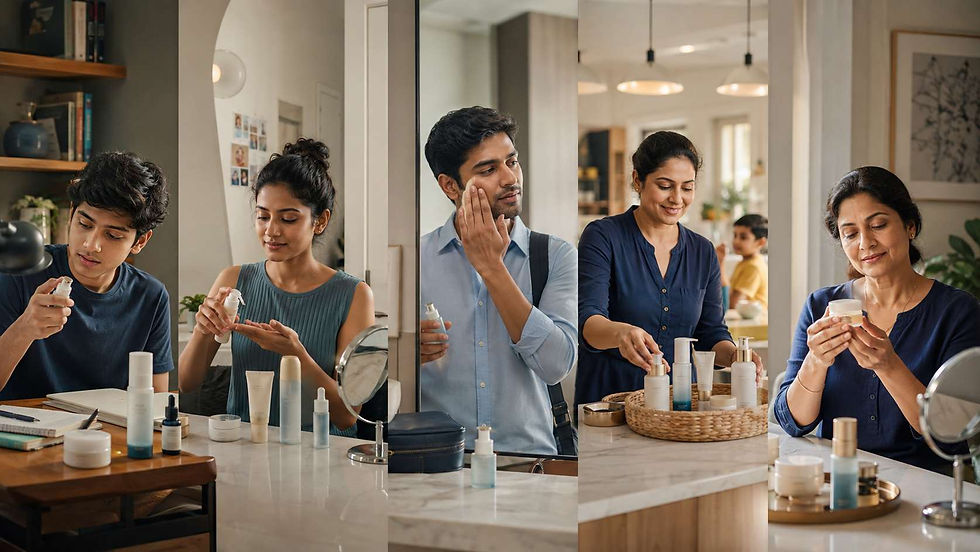

Life stage is more predictive than birthday of K-Beauty Consumer
A 29-year-old student, a 29-year-old professional living alone and a 29-year-old parent may have entirely different beauty behavior. Marriage timing, migration, employment, household composition, commute, parenthood and care responsibilities reshape discretionary cash and routine complexity. MoSPI notes rising proportions of never-married young people and changing marriage patterns, which can extend periods of individual decision-making but individual purchasing power still varies.
Life stage | Beauty job | Economic reality | Strong K-beauty entry |
Teen / dependent learner | Identity, acne/oil concerns, social belonging | Low independent cash; high experimentation; parental influence | ₹199–399 sample/mini, gentle cleanser, lip, small SPF; safety-first language |
College / early adult | First routine, trend participation, photo-ready skin | Lumpy cash flow; deal-aware; peer and creator influence | ₹299–599 door; discovery kit; one hero step rather than routine overload |
First-job professional | Convenient efficacy, commute and office wear | Rising own income but high rent/mobility costs | ₹699–1,199 accessible premium; multifunctional hydration/SPF; easy reorder |
Established professional | Problem-solution, prevention, sensorial upgrade | More stable discretionary capacity; time scarcity | ₹1,199–1,799 hero; regimen pairs; subscriptions only after proven repeat |
Young household / parent | Safety, trust, fatigue-proof routine, gifting | Shared budget and competing household priorities | Trusted essentials, family-adjacent formats, ₹699–1,299 core, value packs |
Mature / affluent | Barrier, dryness, pigmentation appearance, firmness and prestige | Smaller cohort share but higher potential ticket in affluent cells | ₹1,499–3,000+ proof-led specialist or prestige; assisted retail |
SpheraLink life-stage architecture. Price bands are strategic hypotheses to test by category and city, not observed market averages.
Youth concentration shapes the launch map
MoSPI projects Uttar Pradesh, Bihar, Maharashtra, Madhya Pradesh and Rajasthan together to contain about 52% of India’s youth population in 2036. That does not mean these five states should receive identical assortment or media. Maharashtra includes high-income metropolitan demand; Uttar Pradesh contains both large cities and a wide affordability range; Bihar’s consumer and channel economics differ again. Population concentration points to where future consumers live; city-level commercial density determines where imported premium inventory should be placed.
The overlooked mature consumer
The rise of mature consumers is strategically important because K-beauty portfolios are often introduced through products coded for Gen Z: playful packaging, novelty ingredients and trend language. That can unintentionally exclude consumers with strong need and higher capacity. Barrier comfort, dryness, visible pigmentation, sun protection, scalp and hair changes, and sensorial luxury can be communicated without medicalizing age. The mature opportunity is smaller than youth acquisition but may support higher average order value, assisted selling and gifting.
Portfolio implication Use youth culture to accelerate awareness, but design the brand system to travel across life stages. A company that becomes ‘the snail essence for college students’ may acquire cheaply and age badly; a company that owns gentle performance can expand from first routine to advanced routine.
Affordability: consumption, not mythology
India is neither uniformly price-sensitive nor uniformly premiumizing. Both behaviors coexist because income, wealth, household obligations and category involvement are widely distributed. The best official current context is the 2023–24 Household Consumption Expenditure Survey, which covered 261,953 households. Average monthly per-capita consumption expenditure, excluding imputed free welfare items, was ₹4,122 in rural India and ₹6,996 in urban India. The urban figure was about 70% higher, while non-food items accounted for 60% of urban consumption and 53% of rural consumption.
Critical interpretation MPCE is not salary, household income, wealth or a beauty allowance. It is an average per-person consumption measure. It is useful as an affordability denominator and dangerous as a direct beauty-spend estimate.

What an imported MRP means in consumption context
A Beauty of Joseon 50 ml sunscreen observed at ₹1,570 MRP equals about 22% of all-India average urban MPCE and 38% of average rural MPCE. A Minimalist 50 g sunscreen at ₹399 equals about 5.7% of urban MPCE. These ratios do not say who can afford either product: MPCE averages conceal household size, savings, wealth, city costs and category priorities. They do show why the same imported price can feel accessible to one consumer, aspirational to another and economically irrelevant to a third.
Reference purchase | Observed MRP | MRP as % of urban MPCE ₹6,996 | Interpretation boundary |
Minimalist SPF 50, 50 g | ₹399 | 5.7% | Local/reference product; not efficacy-equivalent to Korean sunscreen |
COSRX cleanser, 150 ml | ₹950 | 13.6% | Longer-use product; monthly burden is lower than the bottle ticket |
COSRX snail essence, 100 ml | ₹1,490 | 21.3% | Novelty and proof may support premium among involved users |
Beauty of Joseon sunscreen, 50 ml | ₹1,570 | 22.4% | Faster-depleting daily category; routine affordability matters |
Observed four-step K-basket | ₹6,060 | 86.6% | Initial purchase basket, not a one-month cost; not a mass routine |
Distribution matters more than the average
HCES reports an urban consumption Gini coefficient of 0.284 and a rural coefficient of 0.237. It also shows meaningfully different urban MPCE by household type: about ₹7,606 for regular wage/salaried households, ₹6,595 for self-employed households, ₹4,964 for casual-labour households and ₹9,159 for the broad ‘others’ group. Social-group and state averages differ as well. The implication is not to target or exclude protected social categories; it is to recognize that a national average cannot carry a pricing decision.
HCES lens | 2023–24 urban MPCE | Commercial reading |
Regular wage / salaried | ₹7,606 | Relatively stable monthly cash flow can support replenishment if value is proven |
Self-employed | ₹6,595 | Large and varied group; cash flow may be uneven even at similar annual means |
Casual labour | ₹4,964 | Imported four-figure products face a very high opportunity cost |
Others | ₹9,159 | A broad residual, not a clean luxury segment; investigate composition before targeting |
Four wallets, four different elasticities
Wallet | Consumer question | Price behavior | Winning device |
Discovery | ‘Can I try the Korean thing without regret?’ | Small cash ceiling; high response to novelty and social proof | Mini, sachet, discovery set, credited sample |
Routine | ‘Can I keep buying this when it runs out?’ | Sensitive to depletion and normal selling price | Core size, transparent cadence, bundle saving, reliable stock |
Problem-solving | ‘Will this visibly improve something important?’ | Higher tolerance if proof and fit reduce uncertainty | Hero active/essence, evidence, use guidance, satisfaction support |
Gifting | ‘Does this look generous, special and culturally appropriate?’ | Ticket is occasion-driven; packaging and curation matter | ₹999–2,499 set, festive sleeve, clear recipient/use story |
SpheraLink four-wallet framework.
A consumer can hold all four wallets at different times. The same ₹1,299 product may be too expensive for routine, acceptable as a problem-solver and easy as a gift. Pricing research must therefore specify the occasion rather than ask a context-free question such as ‘Would you pay ₹1,299?’
Geography: states, cities and commercial density
India’s population is geographically broad, while imported premium beauty economics are initially dense. Urban share is projected to rise to 38.6% by 2036, implying roughly 594 million urban residents under the official projection. Yet states with the largest populations are not always those with the highest consumption, best premium retail, lowest delivery cost or strongest K-culture affinity.


A city-cluster model beats a national launch
Cluster | Commercial signature | Price/pack implication | Launch role |
Gateway metros | High premium awareness, creators, organized beauty retail, intense competition and high media cost | Full ladder; hero ₹1,200–1,799; prestige and experiential kits can work | Brand theatre, learning and premium proof |
Tech / professional hubs | Young salaried migrants, digital shopping, time scarcity, ingredient literacy | ₹699–1,499; multifunctional routines; quick replenishment | Repeat economics and creator-to-commerce loop |
Large tier-2 cities | Rising organized retail, strong local influencers, greater cash-risk sensitivity | ₹399–999 acquisition; selective heroes; stronger mini/full-size bridge | Next scale wave after proof |
Beauty-forward regional cities | Language-led communities, weddings/festivals, local beauty retail and salon influence | Gift sets, color/occasion curation, vernacular proof | Regional density and word of mouth |
Long-tail non-metro | Large cumulative population but uneven delivery, authenticity and service | Narrow assortment, door packs, transparent seller, low inventory risk | Digital reach after supply reliability |
SpheraLink city-cluster architecture. Validate city selection using platform demand, delivery, cohort repeat and partner economics.
Do not price states; price demand systems
A brand may be tempted to set lower prices in lower-MPCE states. In a transparent national e-commerce market, unexplained geographic price differences create arbitrage, channel conflict and distrust. A stronger method is to keep coherent MRP architecture while varying the assortment, pack size, bundle, local content, sampling intensity, delivery threshold and channel service. Geographic access is achieved through different doors, not through a confusing map of state prices.
A five-variable city score
Variable | Weight | What to measure before launch |
Reachable category demand | 30% | Search, product-page traffic, category orders, competitor review velocity and local consumer research |
Affordability density | 20% | Premium basket participation, observed ASP distribution and affluent micro-markets—not state average alone |
Channel serviceability | 20% | Authentic stock, delivery time, return rate, quick-commerce dark-store coverage and offline doors |
Cultural / creator fit | 15% | Language communities, relevant creators, event/campus ecosystems and brand-search lift |
Unit economics | 15% | Freight, fulfilment, promo dependence, COD/returns, service cost and contribution after discount |
SpheraLink launch-city scorecard. Weights are a recommended starting point and should change with brand strategy.
Sequencing rule Launch where the brand can learn fastest and fulfil reliably—not simply where the population is largest. A smaller city cell with high repeat and low promo dependence can be more valuable than a metropolitan launch that buys one-time GMV.
Gender, household and the payer–user distinction
Beauty marketing often assumes that the user, payer and decision-maker are the same woman. In India they may be three people: a young user, a parent funding the purchase and an older sibling or creator influencing the choice. In another household, a salaried woman is fully independent; in another, she controls category choice but shares a household wallet. Demographic targeting should therefore separate product need from purchase authority.

Role | Question to research | Pricing consequence |
User | Who applies the product and experiences benefit, irritation, depletion and routine friction? | Sets texture, use frequency, pack control and repeat clock |
Payer | Whose money or credit pays at checkout? | Sets cash ceiling, payment method, discount response and bundle size |
Approver | Who decides whether the purchase is acceptable or trustworthy? | Sets safety proof, authenticity, ingredient and claim language |
Influencer | Who introduces or validates the brand? | Sets creator mix, peer proof, dermatologist/salon role and cultural cues |
Replenisher | Who notices the product is running out and orders again? | Sets reminders, quick-commerce role, pack visibility and stock reliability |
SpheraLink household buying-system framework.
Women are central, but not homogeneous
Women are 48.8% of India’s projected 2036 population in the official series. That tells a company the scale of the population, not women’s control over discretionary spending. Employment, education, marital status, household structure, city, digital access and life stage all change autonomy and category priorities. Marketing should avoid treating ‘Indian women’ as one persona or equating aspiration with purchasing power.
Men and gender-inclusive routines
K-beauty can expand beyond explicitly feminine codes through low-complexity jobs: cleanser, sunscreen, scalp care, oil-control feel and barrier comfort. The commercial barrier is often not benefit relevance but routine friction and category language. A gender-inclusive entry should simplify the first regimen, show quantity and application clearly, and avoid the idea that sophistication requires many steps. ₹499–1,099 is a useful test corridor for mass-premium facial essentials, with higher tiers earned by proof rather than masculine packaging.
The family and gifting multiplier
Indian festivals, weddings, birthdays and visits create beauty gifting occasions that sit outside personal monthly routine budgets. A curated Korean set can make novelty and provenance work in the brand’s favor if it looks generous, contains understandable products and avoids risky shade matching. Gifting also acts as sampling paid for by another wallet. The pack should explain who it is for, what each step does and how long it may last; otherwise the recipient inherits a confusing routine.
Research implication Recruit households, not only individual users. Ask who discovered, approved, paid, received and reordered the product. The answer determines the channel message and the correct price experiment.
Digital access, payments and language
India’s beauty market can scale nationally because digital systems connect discovery, comparison, payment and delivery. TRAI reported 1.0286 billion internet subscribers at December 2025, up from 1.0178 billion at September. At September, urban tele-density was 134.76 connections per 100 people versus 59.52 in rural India, an important reminder that subscription totals include multiple connections and conceal access quality.


Discovery, transaction and fulfilment are separate layers
Layer | Demographic advantage | Failure mode | Pricing response |
Discovery | Short video, Korean culture, creators and search cross city boundaries | High curiosity but low comprehension or trust | Use one benefit, one proof and a low-risk trial door |
Transaction | UPI and platform trust reduce checkout friction | Discount anchoring, counterfeit fear, failed payments or COD abuse | Authorized-seller cues, normal selling price, transparent offer rules |
Fulfilment | Marketplaces and quick commerce make national or rapid delivery possible | Stock-outs, heat exposure, leakage, wrong seller, returns | Price service reliability into the model; narrow launch assortment |
Replenishment | Saved payments and rapid delivery shorten reorder effort | Product unavailable when depleted; consumer substitutes | Place high-repeat SKUs in city-level stock; do not use QC only for launch hype |
UPI changes friction, not affordability
NPCI’s monthly statistics show UPI operating at extraordinary national scale; June 2026 recorded about 22.7 billion transactions worth roughly ₹28.9 lakh crore. Fast payment can make the checkout feel effortless, but it does not create discretionary capacity. Brands should resist mistaking payment convenience for price acceptance. The relevant effect is lower transaction friction and easier replenishment, not permission to ignore cash outlay.
India is a multilingual beauty internet
India recognizes 22 scheduled languages. The latest complete Census language distribution remains 2011, when Hindi accounted for 43.63% of reported mother tongues, followed by Bengali, Marathi, Telugu, Tamil, Gujarati, Urdu, Kannada, Odia, Malayalam and others. Those figures are a historical population map, not a 2026 content-reach model: bilingual behavior, platform language, migration and English usage differ from mother tongue.
Content layer | Recommended language system | Pricing role |
Pack / legal | Comply with mandatory declarations; keep controlled product identity and directions readable | Reduces risk and post-purchase confusion; do not overload small packs |
Product page | English backbone plus high-impact local-language benefit summaries in priority markets | Explains why the premium exists and how long the product may last |
Creator content | Natural code-switching and locally understood sensory words | Turns abstract Korean technology into a familiar benefit |
Customer support | Support the languages of the launch clusters and retain complaint meaning | Prevents avoidable returns and reveals value or use problems |
Search / SEO | Build regional keyword sets; do not mechanically translate English terms | Captures local need states and price-intent searches |
Language principle Translate the consumer’s uncertainty, not only the Korean or English copy. The most valuable local phrase may explain ‘not sticky,’ ‘no white cast,’ ‘how many drops’ or ‘how long one bottle lasts’—because each removes a barrier to paying the premium.
The eight K-beauty demand cells
Personas become dangerous when they turn a country into a set of fictional names. Demand cells are more disciplined: each one states the life stage, wallet, need, channel, price door and reason for repeat. A consumer can move between cells by category or occasion. The cells below are hypotheses for portfolio design and research, not estimates of population size.

Demand cell | Need and behavior | Cash doorway / core | Best first offer |
1. Student trend explorer | K-culture-aware; peer-led; experiments; limited and irregular cash | ₹299–599 / ₹699–999 | Mini or discovery trio; lip, gentle cleanser or compact essence; campus/creator proof |
2. First-job routine builder | Own income; commute; time-poor; wants visible utility and elegant feel | ₹499–799 / ₹899–1,299 | One multifunctional hero plus an easy support product; marketplace + QC reorder |
3. Ingredient-literate problem solver | Compares actives, reviews and methods; pays for distinctive proof | ₹799–1,199 / ₹1,299–1,799 | Hero essence/serum or advanced sunscreen with finished-product evidence |
4. Tier-2 digital explorer | High curiosity; authenticity and cash-risk concerns; local-language influence | ₹399–699 / ₹799–1,199 | Authorized mini/full-size bridge, local creator demo, transparent unit price |
5. Young household optimizer | Competing household costs; wants safe, reliable, low-friction routine | ₹499–799 / ₹699–1,299 | Gentle essential duo; value pack after repeat; giftable discovery at festivals |
6. Affluent performance seeker | High service expectation; buys proof, sensorial superiority and prestige | ₹1,199–1,799 / ₹1,800–3,500+ | Advanced hero, consultation, selective retail and elevated packaging |
7. Gender-inclusive minimalist | Low tolerance for complex routines; functional skin/scalp jobs | ₹399–699 / ₹699–1,099 | Cleanser + SPF or scalp essential; precise use and no gendered over-design |
8. Mature-care upgrader | Barrier comfort, dryness, tone appearance and trust; may prefer assistance | ₹999–1,499 / ₹1,499–3,000+ | Proof-led cream/serum pair, assisted trial, readable pack and support |
SpheraLink strategic segmentation. Price bands are test corridors and must be validated by category, city, pack and normal selling price.
How the cells change one hero SKU
Cell | Same hero, different proposition | Different commercial mechanism |
Student | ‘Your one Korean hydration step’ | 20–40 ml entry; sample value credited toward full size |
First-job | ‘Comfort that works under sunscreen and office air-conditioning’ | Full size at accessible-premium NSP; rapid reorder |
Problem solver | ‘A finished-product result with precise use’ | Higher proof density; low discount; regimen pair |
Tier-2 explorer | ‘Authentic Korean formula, explained in your beauty language’ | Authorized seller, local creator, strong tamper/trace cues |
Affluent seeker | ‘Korean formulation and sensorial ritual’ | Elevated service, selective distribution, gift and travel formats |
Mature upgrader | ‘Comfort, resilience and a routine you can maintain’ | Assisted onboarding, readable instructions, follow-up support |
SpheraLink proposition-translation model.
A cell is only real after repeat
The first purchase can be driven by novelty, a launch discount, a creator or a gift. The cell becomes strategically meaningful when the reason for the second purchase is understood. Cohort analysis should therefore connect acquisition price, product size, expected depletion window, actual reorder distribution, complaint reasons and channel. If the mini converts to full size but the full size never repeats, the brand has solved curiosity rather than routine economics.
Portfolio rule Do not launch one SKU per persona. Launch a small set in which each SKU has a clear job across several cells: one acquisition door, two routine anchors, one proof-heavy hero, one gifting/occasion vehicle and optional advanced upgrades.
India’s observed K-beauty price map
A price architecture must begin with what the consumer sees. On 5 August 2026, observed Nykaa MRPs placed established Korean products across a wide range: ₹500 for an Anua toner mini, ₹600 for an 8 g Laneige lip mask, ₹950 for a 150 ml COSRX cleanser, ₹1,490 for a 100 ml COSRX snail essence, ₹1,570 for a 50 ml Beauty of Joseon sunscreen and ₹2,050 for a 250 ml Anua toner. Sale prices were often lower, but discount depth varied by brand and day.


MRP, selling price and realized price are different
Price layer | Meaning | Decision use |
MRP | Legal maximum retail price, inclusive of taxes | Brand architecture, pack label, discount reference and channel ceiling |
Normal selling price (NSP) | Price seen most often outside major events | Consumer’s learned value and the best routine-affordability anchor |
Event price | Temporary sale price during platform, festival or launch event | Acquisition acceleration; should have a defined floor and funding owner |
Net invoiced / realized revenue | What the brand or importer receives after relevant discounts and commercial deductions | Contribution, cash and channel profitability |
Consumer cost of ownership | Price × depletion and repurchase pattern, plus routine companions | Repeat probability and sustainable category role |
SpheraLink pricing waterfall.
The retail snapshot
Product / pack | Observed MRP | Observed sale price | MRP per nominal ml/g | Price signal |
COSRX Low pH cleanser, 150 ml | ₹950 | ₹855–903 | ₹6.33/ml | Accessible K-core; modest cash premium versus derm/reference cleansers |
COSRX Snail 96 essence, 100 ml | ₹1,490 | ₹1,267–1,341 | ₹14.90/ml | Hero premium supported by distinctive ingredient/category story |
Beauty of Joseon Relief Sun, 50 ml | ₹1,570 | ₹1,570 | ₹31.40/ml | High routine burden in a fast-depleting daily category |
Laneige Lip Sleeping Mask, 8 g | ₹600 | ₹600 | ₹75.00/g | Low absolute entry despite premium unit price; good discovery/gift door |
Laneige Lip Sleeping Mask, 20 g | ₹1,420 | ₹1,420 | ₹71.00/g | Larger cash ticket with small unit-price improvement |
Anua Heartleaf toner, 40 ml | ₹500 | ₹500 | ₹12.50/ml | Mini cuts risk and cash doorway |
Anua Heartleaf toner, 250 ml | ₹2,050 | ₹2,050 | ₹8.20/ml | Full-size value; requires commitment |
Klairs Vitamin Essence Toner, 180 ml | ₹1,700 | ₹1,445 | ₹9.44/ml | Premium toner with visible promotional flexibility |
COSRX Aloe Sun Cream, pack as listed | ₹1,250 | ₹1,000 | Not used | 20% observed discount; selling-price expectations may differ from MRP |
Arencia Mochi Cleanser, 120 g | ₹1,750 | ₹1,750 | ₹14.58/g | Texture/novelty-led premium cleanser |
What the local/reference shelf teaches
Reference product / pack | Observed MRP | Observed sale | Competitive lesson |
Minimalist SPF 50, 50 g | ₹399 | ₹359 | Local science-led brands establish a sub-₹400–500 sunscreen reference |
Dr Sheth’s Ceramide + Vitamin C SPF, 50 g | ₹499 | ₹449 | Ingredient and skin-concern storytelling is available at mass-premium pricing |
Deconstruct Gel Sunscreen, 50 g | ₹399 | ₹379 | Texture claims alone do not automatically earn a Korean premium |
Minimalist Salicylic Acid 2%, 30 ml | ₹549 | ~₹494 | Transparent-active serums train consumers to compare concentration and proof |
Dot & Key barrier moisturizer, 100 g | ₹395 | ₹336 | Barrier language is crowded at a low absolute ticket |
Cetaphil cleanser, 118 ml | ₹459 | ₹418 | Dermatological trust creates a mid-market cleanser anchor |
CeraVe Hydrating Cleanser, 88 ml | ₹359 | ₹323 | A global derm brand can also open below ₹400 through pack size |
The Ordinary Niacinamide, 30 ml | ₹600 | ₹600 | Global ingredient authority competes near accessible-premium levels |
Deconstruct Lip Sleeping Mask, 8 g | ₹295 | ₹221 | Korean lip masks keep premium through brand/sensorial meaning, not format alone |
The premium is category-specific
At MRP, the Beauty of Joseon sunscreen’s nominal price per ml was about 3.9 times the Minimalist sunscreen’s price per gram. COSRX cleanser was about 1.6 times Cetaphil’s nominal per-ml MRP. Laneige’s 8 g lip mask was about twice Deconstruct’s per-gram MRP. These ratios are not quality judgments: ml and g are not always interchangeable, dose differs, and the products are not controlled substitutes. They show that consumers see very different Korean premiums by category.
Category | Likely premium logic | Weak premium logic | Pricing implication |
Cleanser | Distinctive gentle experience, concentrated format, trusted system role | ‘Made in Korea’ on a commodity gel | Keep the cash doorway controlled; earn premium through feel and routine compatibility |
Toner / essence | Korean category authority, novel texture/ingredient, long-use pack | Unclear extra step or generic hydration | Minis and education can unlock a higher full-size MRP |
Sunscreen | Elegant finish, low cast, application comfort and credible finished-product evidence | Imported filter language without India-relevant use proof | High willingness to pay in involved cells; severe repeat risk if depletion is fast |
Lip / sleeping mask | Sensory ritual, gifting, visible brand badge and low absolute entry | Only ‘overnight’ wording | Can carry high unit premium because total ticket remains accessible |
Barrier cream | Superior feel, climate comfort, tested finished product and system fit | Ceramide buzzword alone | Crowded local anchors demand proof or a stronger sensorial edge |
Advanced serum | Distinctive mechanism, evidence, tolerance and product authority | Ingredient concentration arms race without relevance | Hero premium is possible; claims and service must match |
Pricing conclusion A Korean origin premium is a starting hypothesis. The sustainable premium must be rebuilt category by category from uncertainty removed, benefit delivered, sensorial pleasure, routine fit and service reliability.
Routine cost of ownership
Consumers do not use MRPs; they use products. The same ₹1,500 ticket can last six weeks or six months depending on category, dose, body area and behavior. A low-depletion essence may be economically easier than a lower-priced sunscreen that is used generously and replaced often. A company that benchmarks bottle prices without modelling depletion may set an attractive first price and an unsustainable routine.


The three burdens of a routine
Burden | What the consumer experiences | What the company should measure |
Cash burden | Money required today for the bottle or basket | Checkout conversion, price sensitivity, payment mode and cart abandonment |
Cognitive burden | Number of steps, order, dose, compatibility and expected result | Support questions, content completion, misuse, returns and routine drop-off |
Replenishment burden | How often products run out and whether the price remains acceptable | Time-to-reorder distribution, repeat at normal price and substitution during stock-out |
SpheraLink routine-cost framework.
A responsible cost-of-ownership model
For each SKU, estimate uses per day, dose per use, product loss, realistic compliance and pack quantity. Run a low, base and high-use scenario; do not publish an unrealistically low ‘cost per day’ that assumes tiny doses. Sunscreen deserves special care because correct labelled use and reapplication can increase consumption materially. Internal models should follow the product’s directions and study actual use; marketing should not imply that under-application is value.
Input | Low-use scenario | Base scenario | High-use scenario | Evidence needed |
Uses/day | Occasional | Routine-consistent | Label / occasion maximum | Diary or connected cohort |
Dose/use | Observed lower quartile | Median actual use | Directions-consistent upper case | Pack-weight study; product-specific |
Wastage | Low | Expected | Pump/tube leakage or residual | Pack evacuation and consumer test |
Discount | Event price | Normal selling price | MRP | Price history and funding map |
Availability | Always in stock | Expected city service | Stock-out substitution | Channel inventory and lost-sale data |
SpheraLink scenario model. Do not use generic dosing assumptions for claims or medical guidance.
Why the 10-step routine is the wrong entry story
The global cultural image of K-beauty includes layered routines. In India, using that image as an entry prescription magnifies cash, cognitive and replenishment burdens. A stronger commercial narrative is modular: cleanse, protect and add one targeted Korean step. Consumers can expand only when the first module proves its value. This preserves K-beauty’s routine expertise without forcing a ₹5,000–₹10,000 commitment at acquisition.
Routine design rule Sell the next best step, not the maximum number of steps. The most valuable cross-sell is the product that improves adherence and outcome while keeping the household’s replacement calendar manageable.
The price-ladder architecture
A price ladder is not a list of cheap-to-expensive products. It is a migration system. Each rung should answer a different consumer question, have a clear margin role and lead naturally to the next purchase. In K-beauty, the ladder must preserve premium credibility while lowering uncertainty.

Accessible Premium Equation Accessible premium = (credible proof × sensorial pleasure × routine fit) ÷ (cash outlay × replenishment friction × uncertainty). The equation is conceptual: it identifies the levers a company can change when lowering MRP would weaken economics or brand meaning.
The recommended five-rung staircase
Rung | Indicative consumer price | Job | Suitable formats | Margin guardrail |
1. Trial door | ₹199–599 | Turn curiosity into low-risk first use | Sachet, 10–40 ml/g mini, lip, mask, credited sample | Design COGS and registration cost deliberately; do not subsidize forever |
2. Accessible core | ₹699–1,199 | Become a repeatable essential | Cleanser, basic toner/essence, gel cream, simple serum | NSP must work without permanent 20–30% promotion |
3. Hero premium | ₹1,200–1,799 | Prove why this Korean product is special | Advanced essence/serum, elegant SPF, specialist mask | Protect proof and service; promo selectively |
4. Advanced / prestige | ₹1,800–3,500+ | Serve high-involvement or affluent need states | High-evidence treatment cosmetic, premium cream, device-adjacent care | Selective channels; high consultation and experience standard |
5. Routine / gift value | ₹999–2,499 set | Increase basket or transfer trial to another user | Duo, discovery wardrobe, festival/wedding set, travel kit | Make savings real and components understandable |
SpheraLink recommendation. Corridors are starting hypotheses based on observed August 2026 retail anchors, not statutory or market-wide bands.
Category corridors—not one brand corridor
Category | Door | Core | Hero / advanced | What must justify the upper end |
Cleanser | ₹299–499 mini | ₹699–999 | ₹1,000–1,500 specialist | Concentration, distinctive format, residue/rinse experience, sensitivity proof |
Toner / essence | ₹399–599 mini | ₹799–1,299 | ₹1,300–2,100 | Korean category authority, texture, ingredient story, long-use value |
Serum | ₹499–699 mini | ₹899–1,399 | ₹1,400–2,500+ | Finished-product evidence, tolerance, novel delivery or credible Korean expertise |
Moisturizer | ₹399–599 mini | ₹799–1,299 | ₹1,300–2,500+ | Sensory superiority, barrier performance, climate fit and pack |
Sunscreen | ₹399–699 small | ₹799–1,299 | ₹1,300–1,799 | Application feel, cast, pilling, finished-product SPF/UVA evidence and trust |
Lip / mask | ₹199–399 | ₹499–899 | ₹900–1,499 | Ritual, sensory signature, gifting and brand badge |
Hair / scalp | ₹399–699 | ₹799–1,299 | ₹1,300–2,500+ | Water/climate relevance, scalp/hair evidence, format and salon credibility |
SpheraLink category-corridor hypothesis. Validate with conjoint, price experiments and contribution economics; maintain compliant claims.
Nine pricing design principles
Choose the target normal selling price first; set MRP only after deciding the legitimate event-discount corridor.
Anchor the premium to a consumer benefit and proof, not to Korean ex-factory price or a competitor average.
Separate acquisition SKUs from routine-margin SKUs; one product rarely optimizes both jobs.
Use pack size to lower cash entry, but disclose net quantity and unit price transparently.
Model the consumer’s replacement calendar across the whole routine, not one bottle.
Limit overlapping SKUs that differ only by ingredient fashion; they split reviews, working capital and registration cost.
Give each channel a price role and prevent unauthorized sellers from becoming the true price setter.
Set a contribution floor by SKU and channel before approving promotions.
Re-price through evidence and architecture, not constant discounting: better pack, stronger proof, lower fulfilment or origin optimization may solve the gap.
Good–better–best without brand confusion
Tier | Consumer promise | Example architecture | Avoid |
Good | A dependable Korean essential | Simple cleanser/toner, controlled pack, one proof point, ₹699–999 | A stripped product that feels like a different low-quality brand |
Better | The distinctive brand hero | Signature texture/ingredient, stronger evidence, ₹1,199–1,699 | Arbitrary price jump caused only by a trend ingredient |
Best | Advanced performance and experience | Selective range, elevated pack/service, ₹1,800–3,500+ | Prestige MRP with mass discounting and ordinary service |
SpheraLink tier architecture.
Pack architecture: lower risk without cheapening the brand
Pack size is the most underused affordability lever in imported beauty. It changes the cash doorway, trial duration, unit economics, perceived generosity, freight efficiency, registration workload and sustainability story at the same time. A mini is strategically successful only if it gives enough use to judge the product and creates a clear route to full size.

The Anua mini–full-size lesson
The observed Anua Heartleaf toner pair illustrates the trade. The 40 ml mini at ₹500 costs ₹12.50 per ml; the 250 ml full size at ₹2,050 costs ₹8.20 per ml. The mini lowers cash outlay by 75.6% but carries a 52.4% unit-price premium. This can be a fair value if quantity and unit sale price are transparent, the trial duration is adequate, and the consumer is not trapped into repeated mini purchase.
Format | Primary job | When it works | Failure mode |
Sachet / sample | Sensory or compatibility trial | Enough quantity for the product’s judgment window; distributed to relevant users | One use cannot establish the promised benefit; high waste or leakage |
Mini | Reduce cash and commitment | Clear use count, travel utility and full-size bridge | Too small to judge; permanently higher cost for cash-constrained consumers |
Discovery set | Teach a modular routine | Each product has a role; directions are simple; full-size credit | Becomes a ten-step novelty box with no replenishment path |
Core full size | Routine and margin anchor | Good evacuation, realistic replenishment and stable NSP | High ticket, hidden depletion, stock-out at reorder |
Value / refill | Reward retained users | Lower cost per use and credible material/logistics benefit | Large cash burden, refilling hygiene risk or unproven sustainability claim |
Gift set | Occasion and paid trial | Looks generous, avoids shade risk, explains recipient and routine | Decorative packaging with poor product logic |
Registration changes the SKU math
CDSCO’s import framework treats product, variant, pack size and manufacturing premises as controlled elements of registration. Additional pack sizes can therefore require dossier work, fees, endorsement or registration treatment depending on the case. A company should not create ten minis only because they look attractive on a price ladder. Each pack must earn its regulatory, quality, inventory and content complexity.
Pack governance Approve a new pack only when it has one measurable commercial job, a compliant registration path, acceptable unit economics, a clear full-size migration and enough expected volume to avoid dead inventory.
From Korean factory to Indian MRP
The Indian consumer sees MRP; the Korean manufacturer sees ex-factory revenue. Between them sit freight, insurance, customs valuation, origin qualification, border taxes, importer and distributor economics, marketplace or retailer costs, fulfilment, returns, promotions, marketing and working capital. A price that appears generous at the factory can become uncompetitive at shelf or a high MRP can still produce weak contribution.

The end-to-end price waterfall
Layer | Economic question | Owner / evidence |
Ex-factory | What revenue and gross margin does Korea require? | Brand / manufacturer cost sheet |
Freight + insurance | What lane, mode, shipment size and season create landed volatility? | Importer / freight forwarder quotes |
Assessable value | What customs valuation applies to the shipment? | Importer, customs broker and documentation |
BCD + SWS | Does the tariff line and Korean origin qualify for preference? | Current customs tariff, notification, CEPA rule and origin evidence |
IGST | What is paid at import and what credit is eligible/timed? | Tax adviser, importer GST position and cash-flow model |
Importer / distributor | Who funds inventory, compliance, credit and service? | Commercial contract and audited deductions |
Retail / platform | What margin, fees, fulfilment, returns and marketing apply? | Channel term sheet and settlement statements |
Promotion | Who funds the consumer discount and when? | Promo calendar and funding agreement |
Net contribution | What remains after variable cost and deductions? | SKU × channel P&L, reconciled monthly |
SpheraLink landed-price architecture. Obtain qualified customs and tax advice for actual shipments.

How to read the CEPA opportunity
The original CEPA India tariff schedule lists relevant 3304 lines including lip, eye and other beauty/makeup preparations and skincare lines with a 12.5% base rate and staging category E-8. The agreement defines E-8 as elimination in eight stages, becoming duty-free from 1 January of year seven. The commercial inference is that qualifying Korean-origin goods may have zero basic customs duty under the agreement’s staging, but eligibility still depends on current Indian notifications, precise HS classification, product-specific origin rules and proof. Contract manufacturing, non-originating inputs or documentation failures can change the result.
IGST is cash even when it is creditable
HS 3304 is in the 18% GST band, 9% central plus 9% state in the domestic schedule. At import, IGST is charged on the applicable customs base. Eligible input-tax credit may prevent IGST from becoming a final P&L cost, but timing, eligibility and utilization determine the working-capital burden. Finance should model the number of days between border payment and credit use, not simply delete IGST from the spreadsheet.
Illustration on assessable value 100 | BCD | SWS | IGST | Border cash index | Interpretation |
CEPA-qualified assumption | 0 | 0 | 18.00 | 118.00 | Preference subject to live origin and classification validation |
Non-preferential stress test | 20 | 2 | 21.96 | 143.96 | Illustrative downside; not a statement of the live product tariff |
SpheraLink illustration. Stress test assumes SWS at 10% of BCD and IGST at 18% on assessable value + BCD + SWS. Obtain current customs advice.
MRP is inclusive and operational
India’s packaged-commodity system requires declarations including manufacturer/packer/importer details, country of origin, commodity identity, net quantity, month/year of manufacture or import as applicable, MRP, unit sale price, best-before/use-by where applicable and consumer-care information. MRP includes all taxes. From a pricing perspective, this means the printed pack must support the intended national price architecture, and stickers or relabelling must be controlled rather than treated as an afterthought.
Illustrative price build—work backwards
Step | Illustrative value | Management question |
Target MRP | ₹1,299 incl. GST | Is this the correct rung and category signal? |
Consumer value ex-18% GST | ₹1,100.85 | What value remains before trade and channel economics? |
At 15% event discount | ₹1,104.15 incl. GST | Is the discount tactical or the de facto normal price? |
Discounted value ex-GST | ₹935.72 | Who funds the ₹165.13 reduction versus full-MRP ex-GST? |
Less channel / fulfilment / returns | Contract-specific | Are all deductions visible and reconciled? |
Less landed product cost | Origin- and lane-specific | Does CEPA, shipment size or pack design change contribution? |
Contribution | Residual | Does it clear the SKU × channel floor after acquisition cost? |
Pricing discipline Start with the consumer’s sustainable normal selling price and work backward to the maximum landed cost. Do not add margins forward from a Korean cost and hope the resulting Indian MRP finds a market.
Channel, discount and promotion economics
Channels do more than distribute price; they teach it. If a product with ₹1,499 MRP is almost always available at ₹1,049, the market learns ₹1,049 as the real price and interprets full MRP as a penalty. The company must therefore define MRP, normal selling price, event depth, frequency and funding before launch.


Give every channel a job
Channel | Best job | Price architecture | Risk to govern |
Brand D2C | Story, first-party learning, bundles, sampling and community | Stable NSP; exclusive kits/value rather than uncontrolled cuts | High acquisition/fulfilment cost; low organic traffic; data compliance |
Beauty vertical | Education, comparison, trust, reviews and premium discovery | Full ladder; hero pages; controlled events | Discount dependence, paid visibility and platform-owned relationship |
Horizontal marketplace | Reach, search demand and non-metro access | Narrow authorized assortment; sharp door; authenticity cues | Seller leakage, counterfeit fear, price scraping and returns |
Quick commerce | High-frequency replenishment and urgent essentials | Core repeat SKUs; normal price consistency; small bundles | City inventory fragmentation, service fees and substitution |
Selective offline | Touch, texture, assisted trial, prestige and gifting | Hero/full-size ladder; samples and sets; service included | Low velocity, tester cost, inventory and broad rollout too early |
Pharmacy / clinic-adjacent | Trust for gentle/problem-solution care where legally appropriate | Evidence-led core; lower promo intensity | Medicalized claims, channel fit and professional endorsement rules |
A promotion governance table
Promotion | Valid purpose | Maximum learning | Stop signal |
Launch offer | Lower uncertainty and seed relevant first users | Conversion by cell and full-price repeat | Orders vanish after offer; low product engagement |
Mini-to-full credit | Reduce trial risk without teaching a low full-size price | Conversion window and incremental contribution | Consumers repeatedly buy minis; operational cost exceeds conversion |
Routine bundle | Increase adherence and basket while sharing logistics | Attach rate, product-level repeat and routine completion | One product is unwanted or bundle hides weak standalone demand |
Festival / gift | Capture a distinct occasion wallet | New-to-brand recipients and post-gift full-size conversion | Decorative inventory remains after season |
Marketplace event | Acquire at scale or defend a strategic platform moment | Incremental cohorts versus pulled-forward orders | Deeper discount with no retained share or funding visibility |
Loyalty reward | Recognize repeat without lowering public reference price | Retention lift and margin after reward | Reward subsidizes consumers who would have repeated anyway |
SpheraLink promotion-learning framework.
Contribution, not GMV
GMV is the value transacted at the consumer level; it is not brand revenue. The operating dashboard should reconcile consumer selling price, GST, platform/retailer and distributor economics, brand-funded discount, marketplace-funded discount, fulfilment, returns, samples, creator commission, payment cost and landed COGS. If commercial teams see GMV while finance sees net revenue weeks later, the organization will scale the wrong SKU.
Minimum SKU × channel P&L
Line | Required reporting rule |
Units and gross consumer value | Separate MRP, normal price and event-price units |
GST | Show tax treatment and ex-tax consumer value |
Discount funding | Separate brand, importer/distributor and platform/retailer funding |
Commercial deductions | Reconcile every fee, margin, rebate, claim and credit note |
Returns / cancellations | Report units, reason, recoverability and channel |
Fulfilment | Inbound, storage, pick/pack, last mile and quick-commerce placement |
Landed COGS | Include freight, duty, non-creditable tax/cost, brokerage and damaged inventory |
Demand generation | Attribute media, creator, sampling and retail activation at cohort level |
Contribution | Calculate before and after acquisition spend; compare with approved floor |
SpheraLink commercial reporting specification.
Localization by demographic and price
Localization is not making a Korean brand look Indian. It is preserving the brand’s Korean authority while removing the uncertainties that prevent an Indian consumer from paying and repeating. Demography tells the company whose uncertainty matters; price tells it how expensive that uncertainty is.

The localization stack
Layer | Question | Demographic variation | Commercial outcome |
Benefit | What job deserves the price? | Acne/oil, barrier comfort, pigmentation appearance, dryness, sun, scalp or gifting vary by life stage and climate | Sharper willingness to pay |
Formula / texture | Does it work in local use conditions? | Commute, humidity, pollution, water, office AC and routine companions differ | Higher satisfaction and repeat |
Pack | Can the consumer try, understand, store and finish it? | Cash flow, travel, household sharing, eyesight and delivery vary | Lower risk and returns |
Proof | What evidence removes skepticism? | Ingredient-literate youth, parent approvers and mature users need different explanation depth | Premium becomes credible |
Language | Which words describe the desired feel and result? | Regional language, code-switching and beauty vocabulary vary | Better conversion and use |
Channel | Where is trust created and repeat served? | Platform access, offline preference, quick-commerce coverage and payment behavior vary | Reach with controlled cost |
Price | Which doorway and replacement rhythm are sustainable? | Life stage, household role, city and occasion vary | Repeatable unit economics |
SpheraLink localization stack. Climate-product detail should be paired with SpheraLink’s companion Indian Climate × K-Beauty report.
Translate premium into plain language
Weak copy | Why it fails | Stronger India-ready direction |
‘Korean glass skin technology’ | Vague aspiration; can overpromise appearance | Name the cosmetic job, finish, use step and evidence in plain language |
‘77% heartleaf’ | Concentration is not automatically a consumer benefit | Explain what the finished product was designed/tested to deliver and for whom |
‘No white cast’ | Tone range and dose may be unstated | Show defined tone representation, application amount, lighting and test method where substantiated |
‘Dermatologist tested’ | Ambiguous without method, population or outcome | State the exact test and result only when compliant and supportable |
‘10-step Korean routine’ | High cash and cognitive burden | Offer a two- or three-step modular route and explain when to add the hero |
‘Premium imported formula’ | Origin does not answer value | Connect Korean formulation expertise to a measurable or clearly experienced benefit |
Cultural relevance without costume
Hallyu is a discovery bridge. Korean Cultural Centre programming and Indian media coverage demonstrate a visible K-culture ecosystem; platform reports also point to Gen Z and non-metro beauty growth. The responsible commercial inference is that Korean origin can reduce the explanation cost for some consumers. It does not justify using K-pop fandom as a proxy for ability to pay, nor does it remove the need for diverse Indian skin tones, climates, languages and routines in proof and creative.
A demographic creative matrix
Cell | Lead message | Proof format | Price explanation |
Student explorer | One fun, safe Korean step | Short demo, peer review, clear directions | Low cash door; what the mini lets you learn |
First-job builder | Reliable performance in a busy day | Wear/use demonstration and routine compatibility | Cost per realistic use plus fast reorder |
Problem solver | Specific finished-product performance | Method, endpoint, population and limitations | Why this product deserves more than a local active |
Tier-2 explorer | Authentic product explained locally | Authorized seller, traceability, local-language creator | Mini/full-size value and transparent offer |
Affluent seeker | Korean formulation and sensorial distinction | Consultation, texture trial, premium service | Experience, evidence and exclusivity—not discount |
Mature upgrader | Comfort and a maintainable routine | Readable guide, assisted trial and support | Long-use value, regimen logic and service |
SpheraLink demographic communication matrix.
About SpheraLink
SpheraLink helps international companies evaluate and execute market entry in India through market research, regulatory and import planning, product and communication localization, partner sourcing and diligence, pricing and channel design, and launch coordination. This report converts India’s demographic scale into a practical commercial architecture for Korean cosmetics companies.
Explore SpheraLink’s market-entry services: www.spheralink.com/services


Comments